
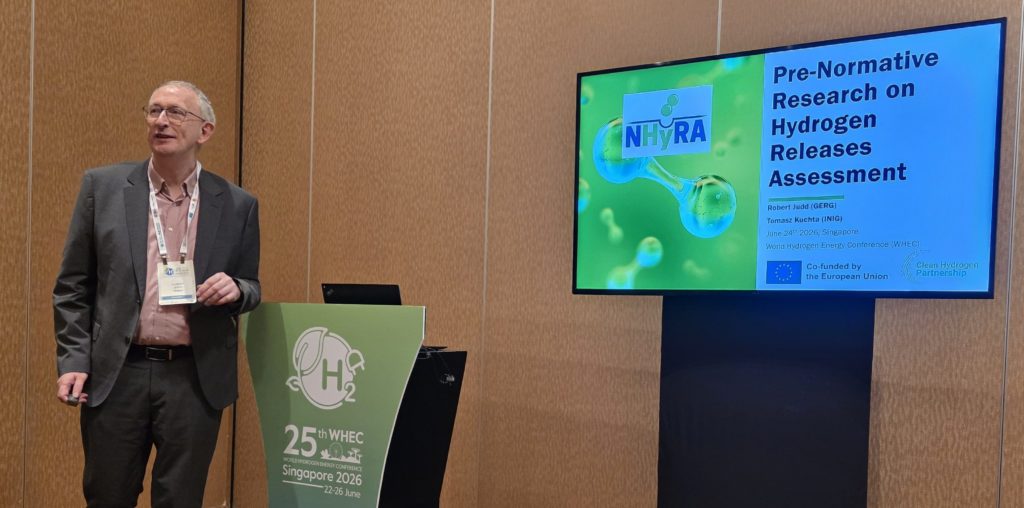
Representatives of the NHyRA project presented the progress in developing methodologies for hydrogen (H₂) release detection and quantification across the hydrogen value chain at the World Hydrogen Energy Conference (WHEC) 2026 in Singapore on 24 June 2026. Robert Judd, Secretary General of GERG – The European Gas Research Group, and Tomasz Kuchta, Senior Specialist in Engineering and Technology at the Polish Oil and Gas Institute, outlined the initial results of NHyRA’s tested standards and procedures to quantify H2 emissions for the WHEC 2026 attendees.
First, the selection of technologies and approaches was explained to run the testing, including high-flow sampling, acoustic imaging and bagging for quantification, alongside portable detectors and passive sensors for detection. The equipment assessed includes the GS 700 H₂, Bacharach Hi-Flow Sampler, Distran Ultra Pro X ultrasound camera and GPD 3010 H₂ passive sensors.
Then, validation process details were outlined. The process combined preliminary testing with measurements in industrial installations, allowing the methodologies to be assessed under practical conditions.
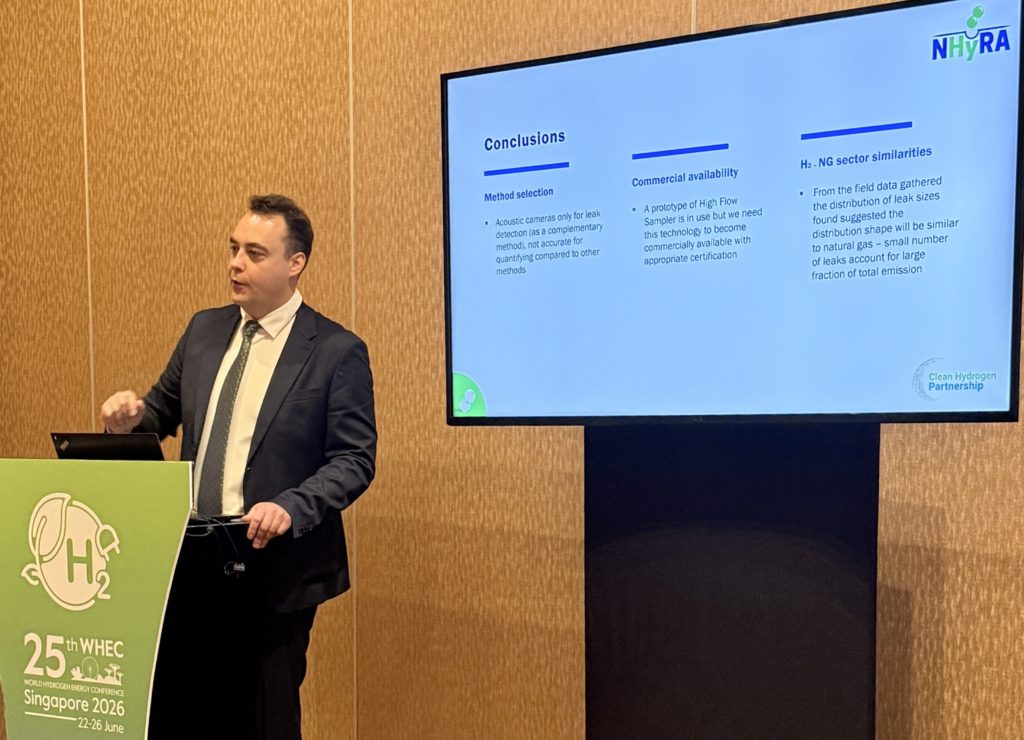
The results presented at WHEC highlight the importance of selecting the appropriate technique according to its purpose: acoustic cameras, for example, are considered complementary tools for leak detection rather than accurate quantification methods. The research has also considered the commercial availability and certification requirements of the equipment, particularly for high-flow sampling, where a prototype is already being used but further development towards commercially available and appropriately certified equipment is required. At the same time, field data indicate similarities between hydrogen and natural-gas leak distributions: a relatively small number of leaks may account for a large fraction of total emissions. These findings provide an important basis for refining the methodology and supporting its future application across hydrogen-related installations.
This work highlights the role of NHyRA in facilitating the integration of hydrogen into the energy infrastructure. As hydrogen deployment expands, understanding where and how releases can occur becomes increasingly relevant for infrastructure operators, industrial stakeholders and future standardisation activities. Moreover, presenting these results at WHEC 2026 demonstrates the relevance of NHyRA’s research, sharing this information with global high-level experts from the hydrogen community. NHyRA is showcasing not only the progress of a specific research task, but also the broader effort to provide robust scientific and technical evidence for the evolving hydrogen economy.