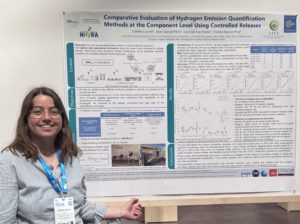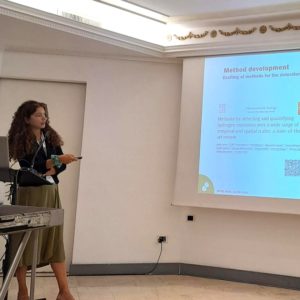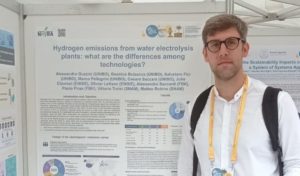

NHyRA project participated in the 21st Conference on Sustainable Development of Energy, Water and Environment Systems (SDEWES 2026) last September 2 through a poster presentation. Attendees at SDEWES 2026 were able to gain a deeper understanding of the Project during the poster session, where Alessandro Guzzini, an Assistant Professor at the University of Bologna, showed the results of a survey sent to expert manufacturers to better identify and characterise the hydrogen (H₂) emissions coming from water electrolysis plants.
The poster focused specifically on the results extracted from a series of surveys fulfilled by manufacturer experts about potential sources of H₂ emissions associated with water electrolysis plants, and the differences that may arise between electrolyser technologies. The survey collected information on the specific origin of those H₂ emissions, and the mitigation measures already implemented or considered by technology developers.
Regarding the H₂ emissions, the survey addressed several aspects of hydrogen emissions from electrolysis plants, including fugitive emissions, emissions occurring during start-up, shutdown and transient operation, and emissions associated with hydrogen treatment. In this same survey, four electrolyser technologies were considered: alkaline electrolysis (AEL), proton exchange membrane electrolysis (PEM), anion exchange membrane electrolysis (AEM), and solid oxide electrolysis (SOEC).
The analysis considered several potential sources, including connections, hydrogen-to-oxygen crossover, start-up and shutdown operations, and gas purification. The survey explored the types of connections commonly used in electrolysis plants, including fittings, compression fittings, welded, threaded and NPT connections, clamps and flanges. The questions also covered other potential sources such as hydrogen-to-oxygen crossover, start-up and shutdown operations, and gas purification.
The second part of the surveys collected information on mitigation measures already implemented or considered by technology developers. These measures include improvements in system and technology design, enhanced monitoring, leak detections, and improved connections and sealing materials, among others. The experts evaluated those solutions taking into account the effectiveness of the measure and its cost.
Results and poster session
The conclusions presented at SDEWES indicate that hydrogen emissions from water electrolysis plants are mainly associated with vented emissions, including purging, start-up, shutdown and gas-treatment operations. Focusing also on hydrogen emissions, fugitive emissions were considered negligible compared with total emissions. At the same time, the results reflect that there is a high uncertainty about H₂ emissions in the literature, with a range from 0.1% to 10%.
Related to the results on mitigation strategies, experts indicate that emission reductions such as improved system designs, monitoring technologies and optimised operation procedures can be achieved with an expected limited cost increase. Now, NHyRA is performing experimental testing of the emissions detection and quantification methods also in electrolysis plants.