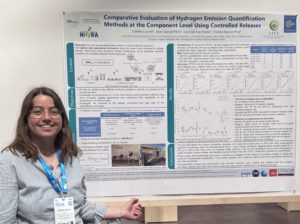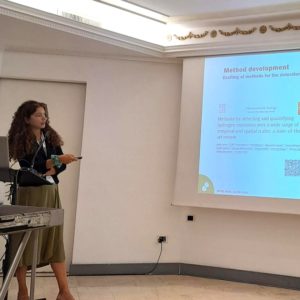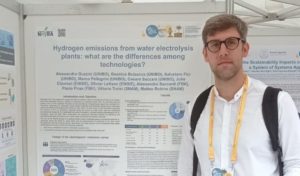
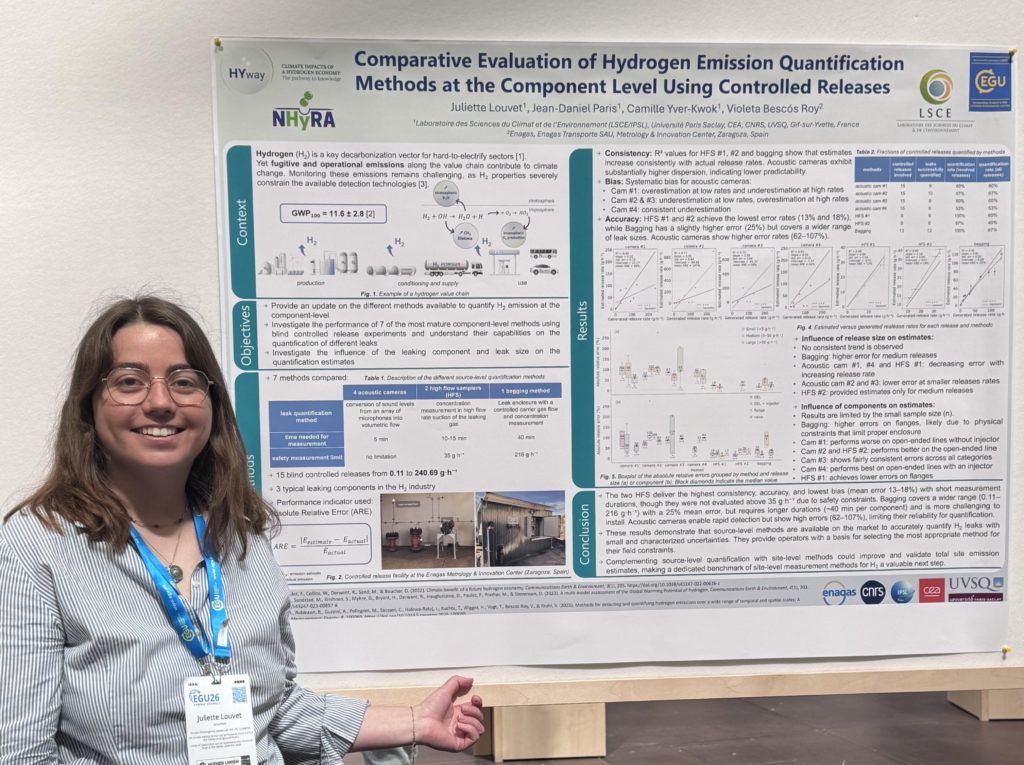
Within the NHyRA project, a benchmark of source-level methods available in the market to quantify hydrogen leaks was carried out, organised by our partner Enagás (represented by Violeta Bescós-Roy, Specialist in Energy Innovation) and with the participation of scientists from Laboratory for Climate and Environmental Sciences (LSCE), leading the analysis of the results. This collaborative work led to the preparation of a poster that was presented by Juliette Louvet, PhD student at LSCE, last May 8 at the European Geosciences Union (EGU) General Assembly in Vienna, Austria.
This study reports on a controlled release experiment to assess the performance and limitations of H₂ component-level quantification methods. Seven different methods were assessed against a series of controlled leaks conducted on a test bench at the Enagas Metrology and Innovation Center in Zaragoza, Spain: a bagging method (leak enclosure with a controlled carrier gas flow), two high-flow sampling methods (concentration measurement via high-flow-rate suction of the leaking gas), and four acoustic imaging methods (converting sound levels from a microphone array into volumetric flow). 15 blind controlled releases up to 313 grams per hour were generated on typical H₂ industry components, including a flange, a valve, and open-ended lines.
Studies like these are key to expanding the safe and sustainable use of hydrogen as an energy carrier. Hydrogen offers strong potential to decarbonise sectors that are difficult to electrify, leading to expectations for a hydrogen production increase in the coming decades. However, H₂ burden in the atmosphere indirectly contributes to climate change by extending the atmospheric lifetime of methane and leading to the formation of stratospheric water vapour and tropospheric ozone. H₂ leaks may occur at connections, and intentional emissions may occur for operational or safety reasons. A current lack of accurate measurements has been identified; therefore, research from projects such as NHyRA and HYway is essential to ensure a sustainable use of hydrogen as a tool for the energy transition.
The poster was unveiled alongside the project HYway, which will also develop hydrogen emissions inventories and scenarios, and novel flux quantification methodologies. Representing HYway, the abstract was co-written by Juliette Louvet, Jean-Daniel Paris and Camille Yver-Kwok.