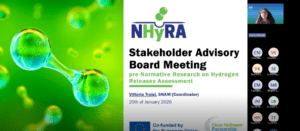
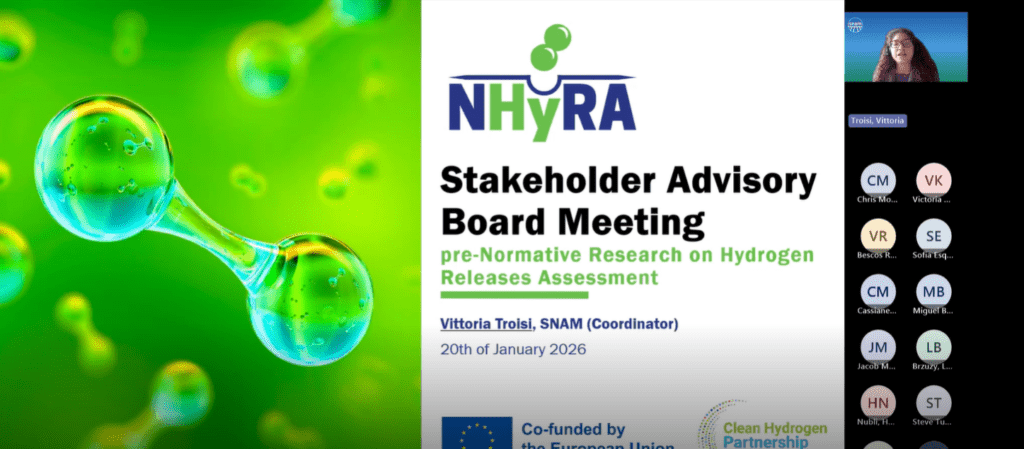
On Tuesday, January 20, the NHyRA project held its second meeting with its Stakeholder Advisory Board (SAB). Through various project representatives, SAB members learned firsthand about the progress made so far and the challenges facing the consortium in 2026, the final year of the project.
First of all, Vittoria Troisi, Decarbonization Technology R&D Specialist at Snam and NHyRA Project Coordinator, welcomed the attendees. In her welcome speech, she gave an overview of the project’s status and objectives, with a focus on developing measurement and quantification methods to determine H2 emissions across the H2 value chain.
Next, Alessandro Guzzini, Research Fellow at the University of Bologna, presented some of the activities carried out in Work Package (WP) 1, which aims to develop an inventory of hydrogen emissions in its value chain. Over the past two years, the project has described the main routes in H2 supply chains, published a first version of the H2 emissions inventory, and a priority list of archetypes and critical elements. As the project draws to a close, the aim is to expand the aforementioned databases.
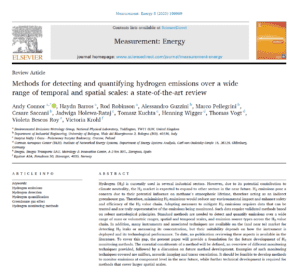
About WP2, which seeks to develop a toolkit of standardised methods for detecting, measuring and quantifying H2 emissions, there were a total of three presentations. Jadwiga Holewa Rataj, head of the Department of Petroleum Engineering at Oil and Gas Institute (INIG), showcased a report containing a list of techniques for detecting and measuring H2 emissions. Then, Tomasz Kuchta, Senior Engineering and Technical Specialist at INIG, detailed a first version of a standard report and improved procedures for detecting and quantifying H2 emissions. Finally, Haris Nubli, Associate Researcher at the University of Surrey, explained the work done in NHyrA regarding the development of a calculation-based method to quantify an emission not covered by the experiments.
Afterwards, it was time for Work Package 3, which focuses on obtaining experimental data through laboratory testing, control release testing and field testing on previously identified methods, apart from feeding the determined uncertainties of those methods and the identified hydrogen releases. Jon Helmore, Senior Research Scientist on Emissions and Atmospheric Metrology at the National Physical Laboratory, gave an update on the activities from this WP. The presentation overviewed the main lessons learnt from the activities regarding the development of performance testing specification and procedures, and on the other hand, the main conclusions drawn from the first field campaign in June 2025.
The last part of the meeting covered the results obtained from the first workshop organised with the electrolyser manufacturers to gather inputs about hydrogen emissions and mitigation strategies. Alessandro Saccardi, Researcher Engineer at the Bruno Kessler Foundation, reviewed the main results obtained from a survey that collected technical information on H2 emissions from electrolyser systems and related mitigation actions to reduce those emissions.
Overall, the workshop served to inform stakeholders about the work results achieved during the first two years of the project. Now, in this final year of the project, it is time to continue along these lines in order to complete all NHyRA’s objectives, which will result in an H2 emissions inventory to serve as a reference for the scientific and industrial community. All of this information will serve to support the use of hydrogen as a renewable energy source, investigating its current gaps and proposing solutions for its more efficient and safer use.